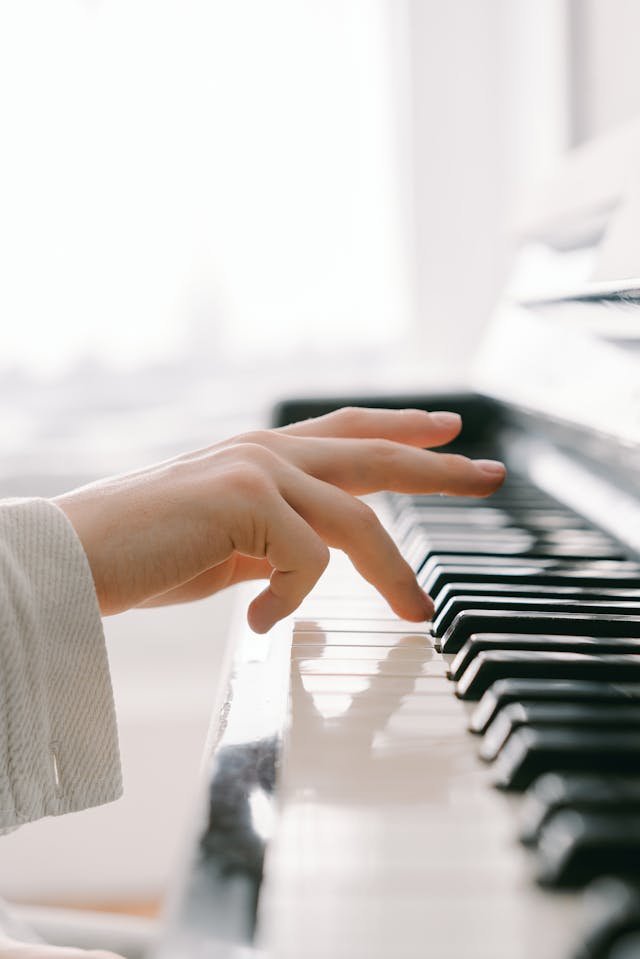
Learning the piano as an adult is often described as “harder,” but that word hides more than it explains. The reality is not that adults are incapable—far from it—but that the process of learning an instrument is shaped by biology, psychology, time constraints, and expectations that change dramatically with age. Understanding why piano feels more difficult later in life reveals less about limitation and more about how human learning systems evolve.
1. The brain becomes less “plastic,” but not rigid
When we are young, the brain is in a highly plastic state. Neural connections form rapidly, and repetition reshapes motor and auditory circuits with relative ease. This is why children can pick up finger coordination, rhythm, and note reading with surprising speed.
As we age, neuroplasticity doesn’t disappear—it simply becomes more selective and slower. The adult brain prioritizes efficiency over exploration. It strengthens existing pathways rather than constantly building new ones. Learning piano requires building entirely new motor maps: independent finger movement, hand coordination, reading two staves simultaneously, and translating symbols into motion in real time.
That process is still possible in adulthood, but it requires more deliberate repetition. What a child may absorb through exposure, an adult often needs to encode consciously.
2. Motor learning becomes more “conscious” than automatic
One of the biggest differences is the shift from implicit to explicit learning.
Children often learn piano in a procedural way. They repeat patterns until the movements become automatic, without needing to analyze what each finger is doing. Adults, however, tend to approach the keyboard analytically:
- “This finger goes here.”
- “This chord is built like this.”
- “I need to think about timing and dynamics.”
This conscious layer is useful at first, but it slows down automation. Piano mastery depends on freeing the mind from individual note-by-note control so that expression and timing can emerge naturally. Adults often struggle because they “over-monitor” their own playing, delaying the shift into muscle memory.
3. Time fragmentation is a major obstacle
Children who study piano often do so in structured environments: lessons, practice time, parental supervision, and fewer competing responsibilities.
Adults face a very different reality. Work, family, cognitive fatigue, and irregular schedules break practice into smaller and less consistent sessions. Motor learning thrives on frequent, spaced repetition. Long gaps between practice sessions weaken retention, forcing repeated relearning.
Even when adults are highly motivated, the continuity required to build fluency is harder to maintain.
4. Fear of mistakes becomes stronger with age
A subtle but powerful difference is psychological. Children are generally more tolerant of sounding “bad” while learning. Adults, however, often carry stronger expectations about performance and self-image.
This leads to:
- hesitation before playing
- frustration with slow progress
- avoidance of difficult passages
- overemphasis on correctness instead of exploration
Piano learning requires a willingness to make repetitive mistakes. Each mistake is data for the brain to refine motor output. But when mistakes feel like failures rather than feedback, learning slows down significantly.
5. Auditory and motor integration takes longer to synchronize
Playing piano is not just physical—it is a continuous loop between hearing, predicting, and moving. The brain must:
- Read notation or anticipate sound
- Translate it into motor commands
- Listen to the result
- Adjust in real time
In children, these loops become tightly integrated over years of practice. In adults, especially beginners, the loops often remain partially separated for longer. You might “know” what to play but still struggle to execute it smoothly.
This gap between intention and execution is one of the most frustrating aspects of adult piano learning.
6. Prior knowledge can both help and hinder
Adults come to piano with rich cognitive frameworks: music listening experience, theoretical understanding, or even other instrument skills. This can accelerate learning in some areas.
However, it can also create interference. Adults may:
- overanalyze music theory instead of developing feel
- compare their progress to professional recordings
- expect faster results because they “understand” music intellectually
This mismatch between understanding and execution can feel discouraging, even when real progress is happening.
7. Physical adaptability changes subtly
Fine motor control remains strong in adulthood, but speed of adaptation declines slightly. Finger independence, wrist flexibility, and bilateral coordination require more targeted repetition than in youth.
It’s not that adults can’t develop these skills—they absolutely can—but the process demands more intentional physical training rather than passive absorption.
8. Motivation shifts from curiosity to discipline
Children often learn piano because of external structure or playful curiosity. Adults usually begin with strong intrinsic motivation: a desire to express themselves, fulfill a lifelong dream, or achieve mastery.
But motivation in adulthood is more fragile. Progress feels slower relative to expectations, and without visible milestones, enthusiasm can fluctuate. Sustained improvement depends more on discipline than excitement.
The important counterpoint: “harder” does not mean “worse”
Despite all these challenges, adult learners often bring advantages that children do not:
- stronger focus and self-directed learning ability
- better understanding of goals and structure
- emotional depth in musical interpretation
- persistence driven by personal meaning rather than obligation
In fact, many adult pianists reach a level of expressiveness that younger learners take years to develop, precisely because they approach music with intention rather than imitation.
Conclusion
Learning piano as an adult is harder not because the door closes with age, but because the learning process changes shape. The brain becomes more efficient but less flexible, time becomes fragmented, and self-awareness increases. These factors create friction—but not limitation.
The piano does not require youth; it requires repetition, patience, and the willingness to let coordination become unconscious over time. Adults may climb the learning curve more slowly, but they often climb it with deeper awareness of why they are climbing at all.